BIM QA: Going Beyond Clash Detection for Stronger, Smoother Projects

When teams think about performing quality assurance for BIM, their minds often jump straight to clash detection. And that’s valid. Clash detection plays a core part in making sure the model and its underlying data will translate to a buildable structure.
Don’t stop there, though. Strong BIM QA needs to start well before clash detection and extend long after it. For example, a model may pass clash detection but still fail QA if elements are missing classification data, asset IDs, fire ratings, or handover requirements. As a result, firms ideally start performing QA before even one element of the project gets modeled, and continue it all the way to handover.
What the experts say about BIM QA today
Thinking BIM QA starts and ends with clash detection limits project outcomes.
“Strong QA is what turns a model into a trustworthy digital asset. BIM models are no longer just design tools. They’re the foundation for decision making across the entire project lifecycle. When models are reliable, teams can use them confidently for coordination, analysis, construction, and operations. When they’re not, BIM loses much of its value.”
— Niknaz Aftahi, CEO and Founder of aec+tech
So what does holistic model validation look like? “BIM QA extends beyond clash detection to include verifying model completeness, data integrity, and adherence to standards before coordination begins,” Patrick Lalonde, Vice President of Digital Project Delivery at EllisDon, says. “It ensures that the information flowing through the project is accurate, consistent, and reliable across all uses.”
As a result, leaders in the industry are shifting away from a focus on geometry to QA processes that reach further and dig deeper. “I typically call them health checks,” Allen Angle, Senior VDC Manager and Owner’s Digital Representative at VIATechnik, explains. “We perform model hygiene and data validation checks.” This way, stakeholders have a model they can trust for downstream processes.
BIM QA 101
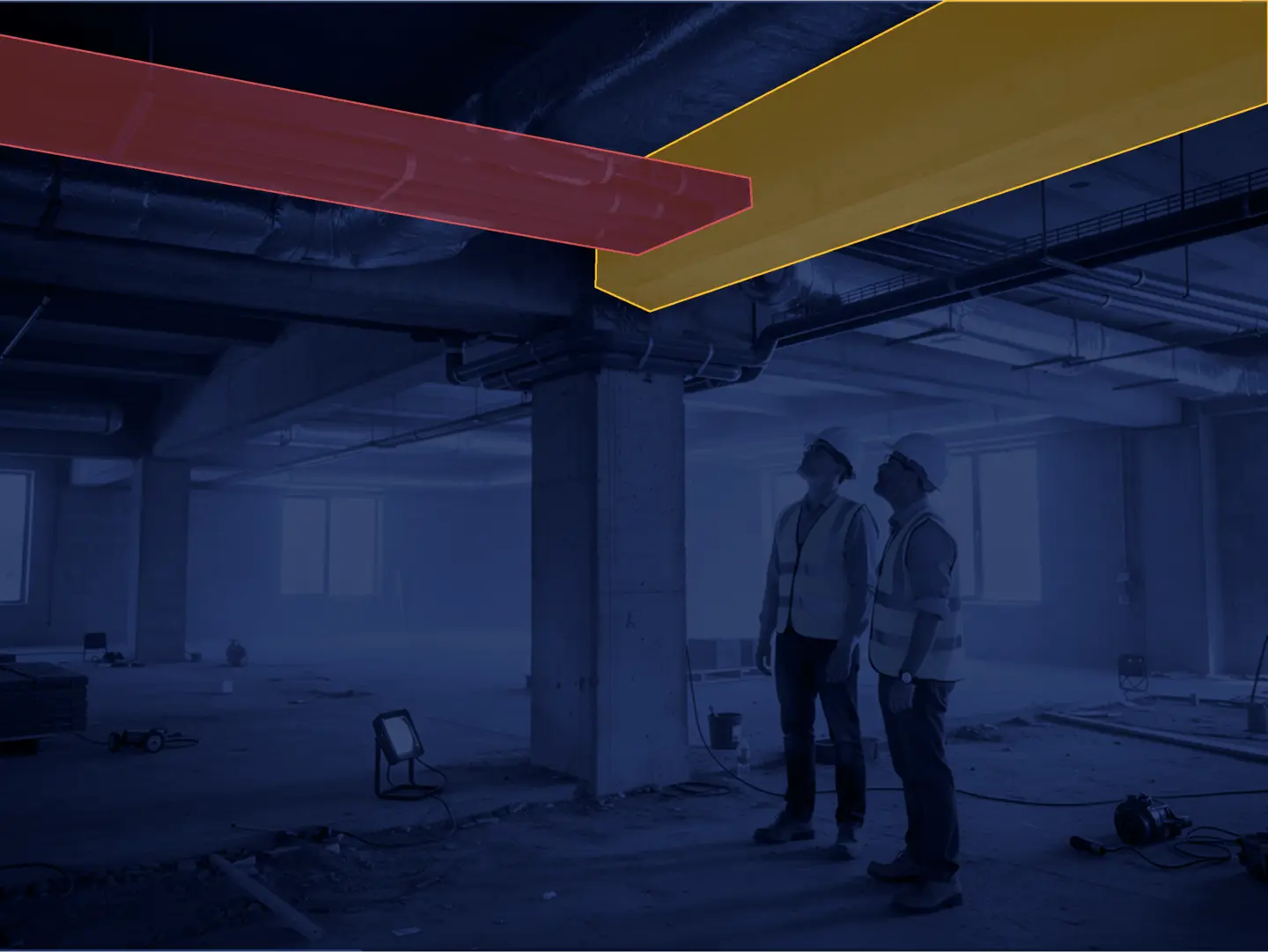
Like many quality assurance processes in AEC, BIM QA focuses on proactively checking for problems. The goal is to catch issues before they can ripple out. Since clash detection is such a commonly deployed piece of BIM QA, it serves as a useful example. If an MEP clash gets caught in the model, teams can remap ductwork or conduit. That’s a lot cheaper, easier, and faster to do in the model than in the field.
But that’s just one example. “BIM quality assurance goes far beyond clash detection,” Aftahi says. “It involves verifying that models are structured correctly, that data is complete and consistent, and that standards are followed across teams. It ensures that the model is usable not only for coordination, but also for analysis, documentation, and operations.”
In other words, strong BIM QA doesn’t just check the model’s geometry. It’s a more robust process that looks for consistency and accuracy in all of the contained data, from clearances to classifications to compliance with regulatory requirements.
This makes the model useful to support — and potentially even automate — downstream processes like:
- Scheduling (4D BIM)
- Cost estimation (5D BIM)
- Sustainability analysis (6D BIM)
- Facility management (7D BIM)
- Material takeoffs
- Prefabrication
Just as importantly, BIM QA helps the project yield a model that’s ready for facilities management.
If the owner wants to create a digital twin or plug data into its computerized maintenance management system (CMMS), AEC firms need to be ready to hand over a clean, accurate model.
“I want the geometry to be good, but getting the data has been the opportunity to get facilities people to actually use BIM. Then, they get excited and look to see how they can better use the data.”
— Allen Angle, Senior VDC Manager and Owner’s Digital Representative at VIATechnik
5 components of robust BIM QA
“A strong BIM QA process includes model validation checks, data and version control management, structured clash detection workflows, issue tracking, and adherence to coordination standards,” Lalonde says. “It also requires consistent processes for documenting decisions and maintaining alignment across teams.”
That’s a lot, so it helps to break the BIM QA process down into pieces. To yield the best results, this quality assurance effort should include:
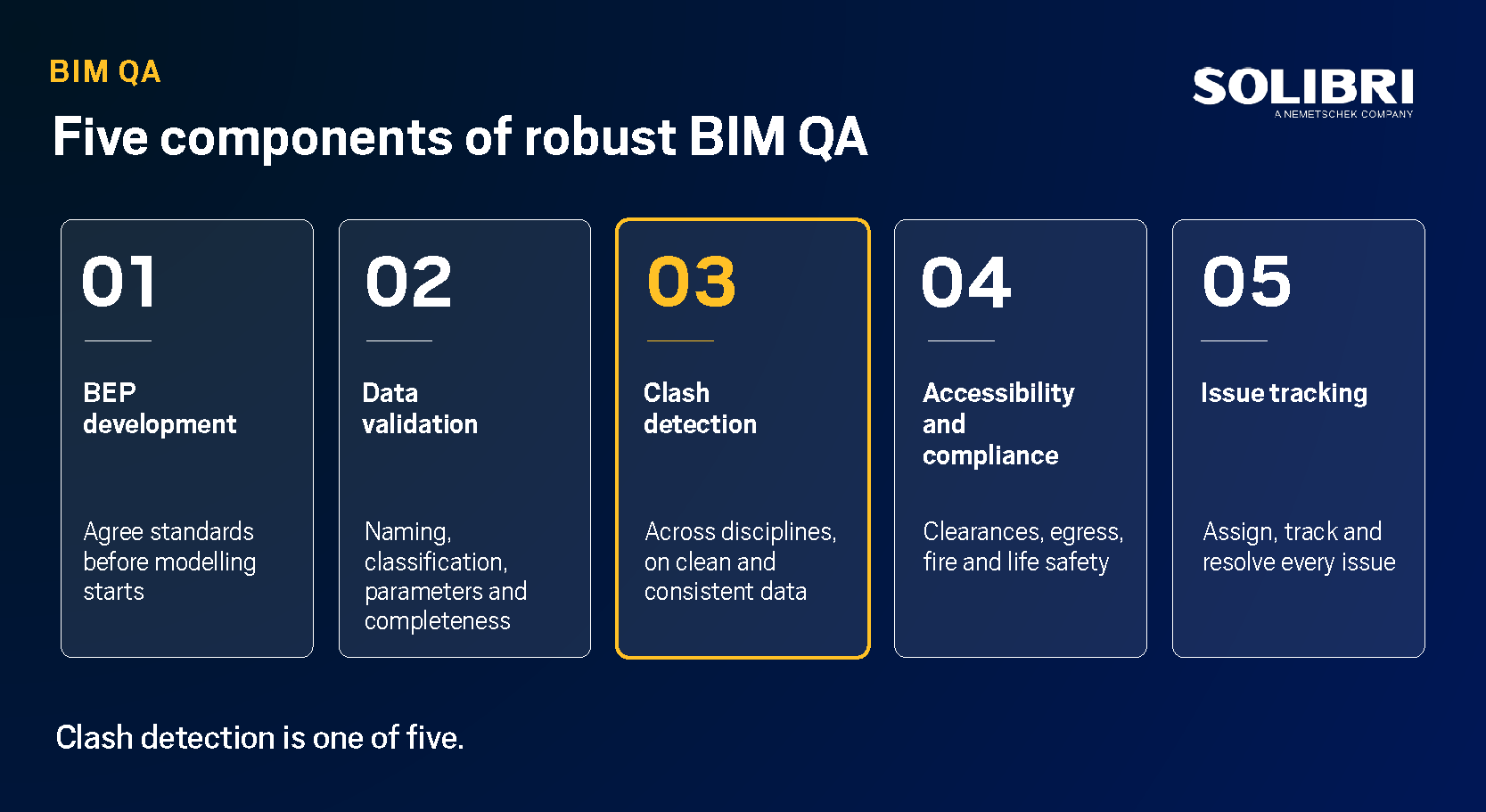
#1: BEP development
BIM QA needs to start before modeling does. Leaders need to agree to set protocols and standards for the model and its underlying data. Without this in place, teams lack something solid against which to check the model. That makes QA significantly harder.
Fortunately, there’s an established way to set standards to guide BIM QA: a BIM execution plan (BEP). As Aftahi explains, “Strong QA processes are continuous across project phases, clearly structured, and aligned with the BIM execution plan.”
That plan should include details about the ways team will satisfy project requirements in terms of:
- Project goals and milestones
- Overarching standards
- Naming standards
- Classification standards
- File format standards
- Roles and responsibilities
- Version control protocols
- Coordination procedures
- QA processes
- Data security, including user access, policies
- Handover requirements
When owner requirements get captured in the BEP and teams continuously perform QA against those standards, it results in the required deliverables.
#2: Data validation and model completeness
We recently published a guide exploring data validation in more detail, so we’ll keep this relatively brief. In the same way clash checking looks for spatial issues, data validation looks for data issues. Those include inconsistencies in:
- Naming conventions
- Parameter mapping
- Object classification
- Measurements
Data validation also checks for property completeness in both model elements and the underlying property sets required. It might check that all air handling units (AHUs) include metadata capturing their manufacturer, model number, airflow capacity, power requirements, filter specifications, maintenance schedules, and asset IDs, for example. Data validation also looks for duplicate or blank values.
With so much data captured in the model, this validation could be a grueling process. But technology can automate it using rules teams establish for each project or across their portfolio.
#3: Clash detection
This is another area where we won’t dive deep because so many people already have familiarity. What we will say is that for clash detection to be meaningful, it needs to happen across disciplines. Strong BIM QA yields a model in which data is consistently formatted. This way, clash detection checks work as intended, even with model data from various stakeholders (e.g., the MEP subcontractors).
Once all the data is integrated into a clean federated model, automating clash detection can help deliver efficiency gains and increased accuracy.
#4: Accessibility and compliance verification
Even geometry-based BIM QA shouldn’t stop at checking to see if solids intersect. Stakeholders also need to make sure that what’s planned allows for proper clearances. That means confirming that serviceable elements have sufficient access for maintenance personnel and that egresses meet fire and life safety requirements.
Clearance checks also play a key role in accessible design. Checking for sufficient space for wheelchair turn radii, for example, makes buildings useful for all. It also helps confirm compliance with regulations like the Americans with Disabilities Act (ADA).
Teams should establish clearance rules to check for compliance with fire safety and accessibility requirements. This makes BIM QA more robust and helps avoid late-stage headaches when trying to appease regulatory authorities.
#5: Issue tracking and resolution
Merely flagging an issue is the start. But true quality assurance means taking that problem and correcting it. To make sure this happens, teams need to track issues in a systematic way.
BIM QA issue tracking becomes most effective when the QA team has a way to assign resolution for each issue to the appropriate stakeholder(s). “QA only works when roles are clearly assigned across architects, engineers, contractors, and BIM managers,” Aftahi says.
An automated system that allows the QA team to track the status of each issue helps to make sure everything gets addressed by the required time. Then, issues should get resolved before problems can trickle out to the field.
The difference-maker: Continual QA
“QA should be structured as a continuous process across design, preconstruction, and construction phases, with defined roles and responsibilities captured in the BIM Execution Plan,” Lalonde says. “It should include regular coordination meetings, milestone-based checks, and clearly defined workflows that align all stakeholders.”
“On a traditional design-bid-build project, we’re going to have QA checks in each of the design phases,” Angle adds. “You’re supposed to have this parameter in the model. Do you?”
Aftahi echoes this sentiment, saying, “The key is to treat QA as continuous. Early phases focus more on structure and coordination readiness. Later phases place more emphasis on data quality, documentation, and deliverables.”
All of these experts say the same thing: BIM QA only works when it happens from the first phase of the project all the way to handover.
What you get with full-scale BIM QA
Applying this kind of BIM QA requires more investment from the team (although strong software can alleviate a lot of the lift here). But that investment often pays off manyfold. Strong BIM QA:
- Catches errors when they’re cheapest and easiest to fix
- Minimizes delays and rework
- Makes sure model data can be used downstream
- Aligns the project behind standards and regulations
- Supports collaboration by creating a model all stakeholders can trust
- Enables better sustainability analysis
- Delivers a model that meets the owner’s needs for facilities management
With all of these benefits, good BIM QA delivers savings at scale.
“BIM QA is critical because it directly impacts project certainty. It reduces errors, minimizes rework, improves coordination, and supports better decision-making. Ultimately, it ensures that digital models translate effectively into real-world outcomes, protecting cost, schedule, and overall project performance.”
— Patrick Lalonde, Vice President of Digital Project Delivery at EllisDon
We built this guide to help teams perform more robust BIM QA for better project outcomes. But we didn’t stop there. We have a solution specifically built to help teams perform the necessary QA. It includes functionality for Information Delivery Specification (IDS), the openBIM standard that essentially acts as a machine-readable BIM QA checklist.
To learn more about how Solibri supports full-scale BIM QA across the whole project, contact us.