How BIM Validation Prevents Commissioning Delays in Data Center Projects

Commissioning is the moment a data center stops being a construction project and starts being a live facility. It is also the moment where problems that were quietly built into the model months earlier finally surface, at the worst possible point in the schedule to discover them.
Why Commissioning Is Where Coordination Failures Get Expensive
By the time a data center reaches commissioning, most of the physical work is done. Power distribution is installed. Cooling systems are in place. Cable trays, containment, and IT infrastructure are ready for testing. Commissioning teams run through integrated systems testing to confirm the facility performs as designed under real load, redundancy failover, and thermal conditions.
This is also where undetected coordination problems stop being theoretical. A clearance issue that never caused a visible clash during construction can prevent a technician from accessing a breaker during a failover test. A misclassified fire damper can fail an inspection. A cooling system that was never validated against the actual electrical load it needs to support can underperform the moment the facility goes live. None of these issues show up as a geometric clash. They show up as a failed commissioning test, months after the model that caused them was signed off.
The Data Behind the Delay
Commissioning delays rarely trace back to a single dramatic error. They usually trace back to a model that looked coordinated but was not fully validated: geometry that did not clash, paired with equipment data, classification, or rule compliance that was never checked with the same rigor.
This distinction matters because most coordination workflows are built around clash detection, which answers whether two objects occupy the same space. It does not answer whether the equipment behind that geometry meets the specification the commissioning team will test against, whether accessibility and maintenance clearances meet code, or whether the redundancy configuration (2N power, N+1 cooling, or the project’s specific requirement) is consistently modeled across every affected system. A model can pass every clash check and still fail commissioning, because clash detection was never designed to catch that category of problem.
Where This Compounds on Repeatable Campuses
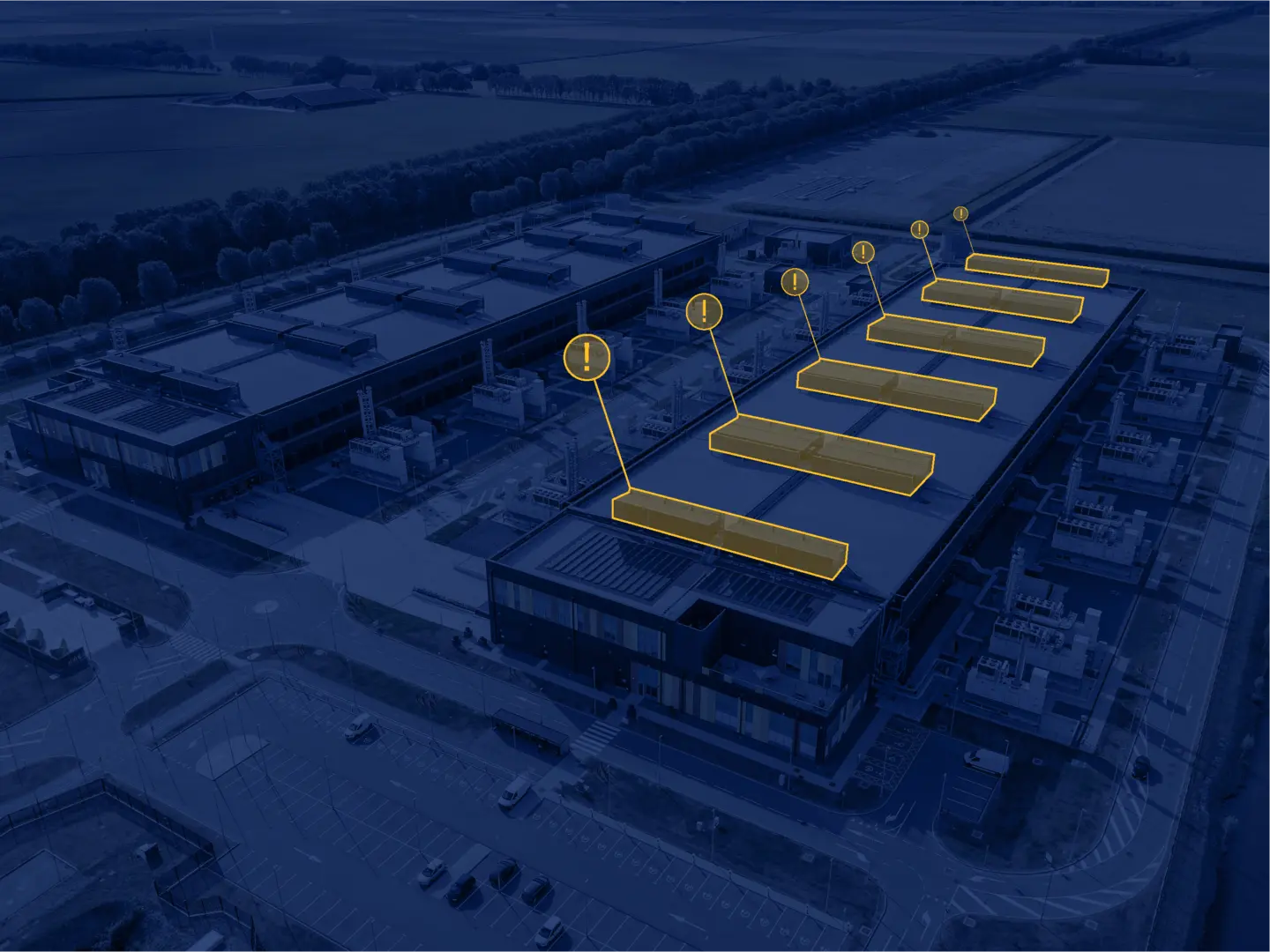
On a hyperscale campus built from repeated data hall designs, a validation gap in the template does not stay contained to one hall. If the first data hall passes construction with an unvalidated clearance issue, every subsequent hall built from the same coordinated model likely carries the same gap. Commissioning teams may not discover the problem until they reach the hall where it actually causes a test failure, at which point every other hall built from the same template needs to be checked as well. What looked like an isolated commissioning delay in one hall becomes a portfolio-wide remediation effort.
Catching It Before Commissioning, Not During It
The teams that avoid this pattern build validation into the process well before commissioning begins, rather than treating commissioning as the first real test of whether the model was right. That means:
- Validating equipment clearances against manufacturer specifications and code requirements during design and construction, not assuming a passed clash check covers this.
- Confirming redundancy configuration is modeled consistently across every system it touches, not just documented in a specification that the model itself does not reflect.
- Re-validating each repeated data hall in a campus rather than assuming the first validated instance guarantees every later one is correct.
- Maintaining a dated, auditable record of what was validated and when, so commissioning teams are confirming a known-good model rather than discovering its condition for the first time under test conditions.
This is the practical difference between a model that is coordinated and a model that is validated. Coordination means the geometry does not conflict. Validation means the model has been checked against the rules that actually matter for a facility guaranteed to run at full uptime from day one.
For a full breakdown of how this connects to the LOD requirements data center models need to reach before they are ready for this level of scrutiny, see our guide on LOD 400 and BIM validation requirements for data center construction.
Building Commissioning Readiness Into the Model, Not Just the Schedule
Commissioning delays are often treated as a scheduling problem to manage rather than a modeling problem to prevent. In data center construction, where the cost of a delayed go-live is measured in lost revenue for the tenant and reputational risk for the developer, that framing gets the sequence backward. The facility that commissions cleanly is almost always the facility whose model was validated consistently long before the commissioning team ever walked the floor.
The same validation gap can also show up earlier, as rework during fabrication or construction. For a closer look at the cost side of this problem, read The True Cost of Rework in Hyperscale Data Center Construction.
Want a structured way to build this into your next project? Download the Data Center BIM Coordination Checklist for a step-by-step framework covering exactly this, from LOD confirmation through the prefabrication handoff to the audit trail commissioning teams will want to see.
Get the Data Center BIM Coordination Checklist
This site is protected by reCAPTCHA.