MALD: How the Model as a Legal Document Is Changing the Future Landscape of Transportation Digital Delivery Projects

As building information modeling (BIM) becomes more widely used, more and more professionals are turning to 3D planning measures. That includes state and federal agencies across the U.S., which are driving digital delivery, setting new industry benchmarks. By leveraging 3D coordination, BIM allows public agencies to more consistently deliver improved project outcomes.
These changes are impacting the transportation sector, too. The Federal Highway Administration (FHWA) recommends BIM use, and state Departments of Transportation (DOTs) are piloting project deliveries that utilize BIM, too.
Recently, the 3D model has served as a supplement to 2D contract documents on transportation projects. But even that is starting to change. Many DOTs are piloting programs to develop the workflows and outcomes of requiring the model as a legal document (MALD). We spoke with Michael Warren, Digital Growth Lead at AECOM — the largest design firm by revenue, per ENR rankings — about this evolving field.
MALD pilot projects are in the works across the U.S.
Warren told us that BIM is nothing new. He pointed out that certain cities started accepting models around two decades ago, operating under the expectation that BIM would give teams better information.
The FHWA does not mandate but recommends the use of BIM for infrastructure and the number of DOTs interested in enhanced digital delivery via modeling is growing. Many have leveraged BIM for some time now. Warren said it’s not uncommon to read through hundreds of pages BIM requirements for highway projects in order to write the required BIM execution plan (BEP) for that project.
Still, DOTs have largely been on the same path as private AEC projects, using the model for supplemental information but not establishing it as a legal document. That said, pilot projects currently underway indicate that’s likely to change.
State and federally supported transportation agencies are under pressure to deliver safer, more cost-effective projects faster. BIM can help there, and are consequently piloting MALD projects.

The Utah Department of Transportation (UDOT) has greenlit full MALD projects under its digital delivery umbrella, for example. The Pennsylvania Department of Transportation (PennDOT) started piloting MALD projects in 2023.
Similarly, the Texas Department of Transportation (TxDOT) has been piloting a MALD program, and a number of DOTs are working on development in tandem with and through the FHWA pooled fund grant program. TxDOT has issued guidance saying that under this pilot, it’s “transitioning from traditional project delivery to digital delivery methods with the model as the legal document.”
The American Association of State Highway and Transportation Officials (AASHTO) has even issued guidance to help state transportation agencies assess their readiness to be able to adopt the model as a legal document.
In short, state and federal transportation agencies are increasingly adopting or looking to adopt MALD.
“As DOTs and the FHWA started to realize the benefits of data-rich 3D models and vendors started to create software products that could deliver things in the transportation space, it got fascinating. The world opened up.”
— Michael Warren, Digital Growth Lead, AECOM
Firms working on public transportation projects should be ready to leverage the model not just as supplemental information, but as a legally binding contract document. That means it can be reliably referenced for design intent, construction, and even quantities. For all of this to work, though, the model needs to be accurate.

Requirements for MALD: Why model-checking is so critical
For the model to function as a legal document, it needs to be viewed by all stakeholders as equally trustworthy as 2D contract drawings. That means the model needs to be:
Accurate
First and foremost, MALD programs only work when the model delivers the same level of accuracy that AEC professionals expect from traditional 2D contract documents. Many firms have structured, proven quality assurance (QA) and quality control (QC) processes for their 2D workflows. They might not have the same level of rigor established for 3D modeling.
Fortunately, in some ways, it’s easier to check the model for accuracy. 2D drawings often need to be overlaid to look for clashes. With the 3D model, software can often automate the process of checking for intersecting solids. More sophisticated software can check for other types of clashes, too, like accessibility and clearance checks.
That’s particularly valuable for transportation projects, which require consistent maintenance. The model allows teams to confirm that workers have sufficient space to access valve handles or clean bridge scuppers, for example.
It’s one thing for the design team or the general contractor to develop a model and confirm its accuracy, though. It’s another to maintain the required level of accuracy once models from subcontractors come into play.
MALD programs function best when they leverage a federated model — one that combines all modeled elements together into one cohesive model. Then, to build in the accuracy required for that federated model to function as a legally binding document, stakeholders can undertake coordination efforts to remedy clashes and maintain the required level of fidelity.
How model-checking helps
BIM model-checking software is literally designed to help AEC professionals create models that represent the planned or built environment as accurately as possible.
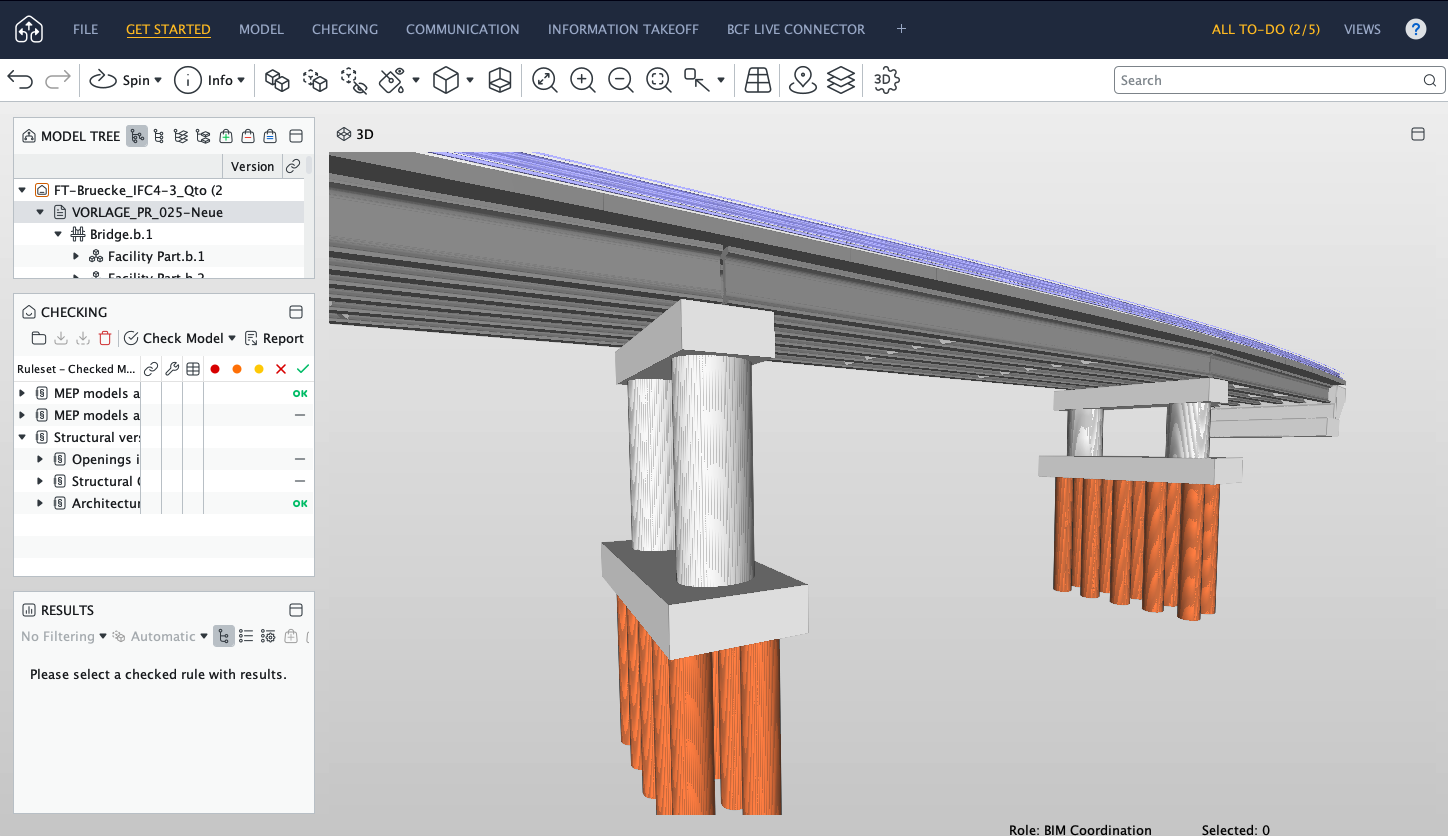
Specifically, rule-based detection functionality helps teams arrive at a model that’s strong enough to function as a legal document. By establishing rules in the model-checking software, then running the federated model through those rules, teams get a way to quickly and thoroughly evaluate the model. They can look for everything from geospatial inconsistencies to alignment (or lack thereof) with regulations and standards.
Say, for example, that one subcontractor created a void in their model to hold space for a clearance. When their model is pulled into the federated model, the void could clear elements other contractors have modeled in that space. A strong model-checking software can look for and flag that issue throughout the model so key elements aren’t missed.
This helps teams avoid issues that could require rework, contributing to budget overruns, safety issues, and more.
“With Solibri, you can check model integrity. Were the elements in the model created meeting ISO [International Organization for Standardization] or other industry standards for what a model should contain? Then, [for clash detection], the tool will take you to views that are already established or create new ones — preferably a three-dimensional isometric view — that clearly demonstrates we have an interference.”
— Michael Warren, Digital Growth Lead, AECOM
Accessible through standardization
While many AEC professionals primarily think of BIM as a way to detect geospatial clashes, projects that apply MALD can also tap into semantic rules. These help to standardize the results from modeling efforts. This way, both the model and the metadata attached to it are accessible and understandable to all stakeholders, from owners to subcontractors.
Many agencies have adopted or are in the process of adopting openBIM standards, including the Industry Foundations Classes (IFC) standard. With this platform-agnostic file type, all stakeholders should be able to use the model within their own modeling platform of choice. In this way, the model is widely accessible instead of being tied to a proprietary authoring software.
Beyond that, standardization helps people leverage the model for improved project outcomes. Establishing semantic rules locks in consistent naming conventions. This way, teams can reliably use the model to analyze specific project elements (e.g., all floors), perform quantity takeoffs, and more.
As construction equipment advances, too, machinery like motor graders and asphalt pavers can use model data to perform automated work. Accessible model data helps those tools ingest the data so that it can guide production.
“Now, a lot of DOTs are classifying cell libraries or object libraries that you must use on their projects.”
— Michael Warren, Digital Growth Lead, AECOM
How model-checking helps
With semantic rules, a strong model checking software allows stakeholders to validate the data in the model. They can confirm that teams have aligned with naming conventions and other data formatting to make the model accessible.
This, in turn, helps the model function as a single source of truth for all project stakeholders. With strong QA/QC processes surrounding that model, it guides teams forward in the same direction. This helps to avoid delays and budget overruns — a critical goal on FHWA/DOT projects where taxpayer dollars and road congestion are at stake.
Accepted
Finally, for MALD to work, the model needs to be accepted by all stakeholders as a legally binding document. The contract language should set precedence here, going so far as to specify that the model wins in the case of a conflict between the model and 2D drawings.
For the model to be accepted — and acceptable — as a legally binding document, it needs to provide a sufficient level of development (LOD). Usually, the model needs to increase in LOD as the project progresses, eventually arriving at an accurate representation of the built environment.
This as-built model is useful for publicly-funded infrastructure projects because it can be leveraged for maintenance, inspection, and asset management. Supported by advancements in photogrammetry, the model can act as a digital twin of the built infrastructure. Warren points out that this then helps teams identify what kind of maintenance or remediation is needed in order to keep people moving safely across that project through the years.
How model-checking helps
Acceptance of the model requires teams to have confidence that it’s accurate and provides the necessary level of detail. The right model-checking software helps AEC professionals check all of the granular details in a model and confirm the quality that it needs.
Reaching accurate, accessible, accepted models isn’t just valuable for AEC firms pursuing publicly funded projects. Government agencies across the world — from Finland to Singapore — increasingly require BIM. Implementing a reliable model-checking software helps AEC companies stay compliant with MALD and other similar requirements, while also supporting on-time, on-budget projects.
To see firsthand how Warren and AECOM utilize Solibri to check infrastructure models, you can watch this webinar. To explore what this kind of software could do for your AEC firm, contact our team at Solibri today.