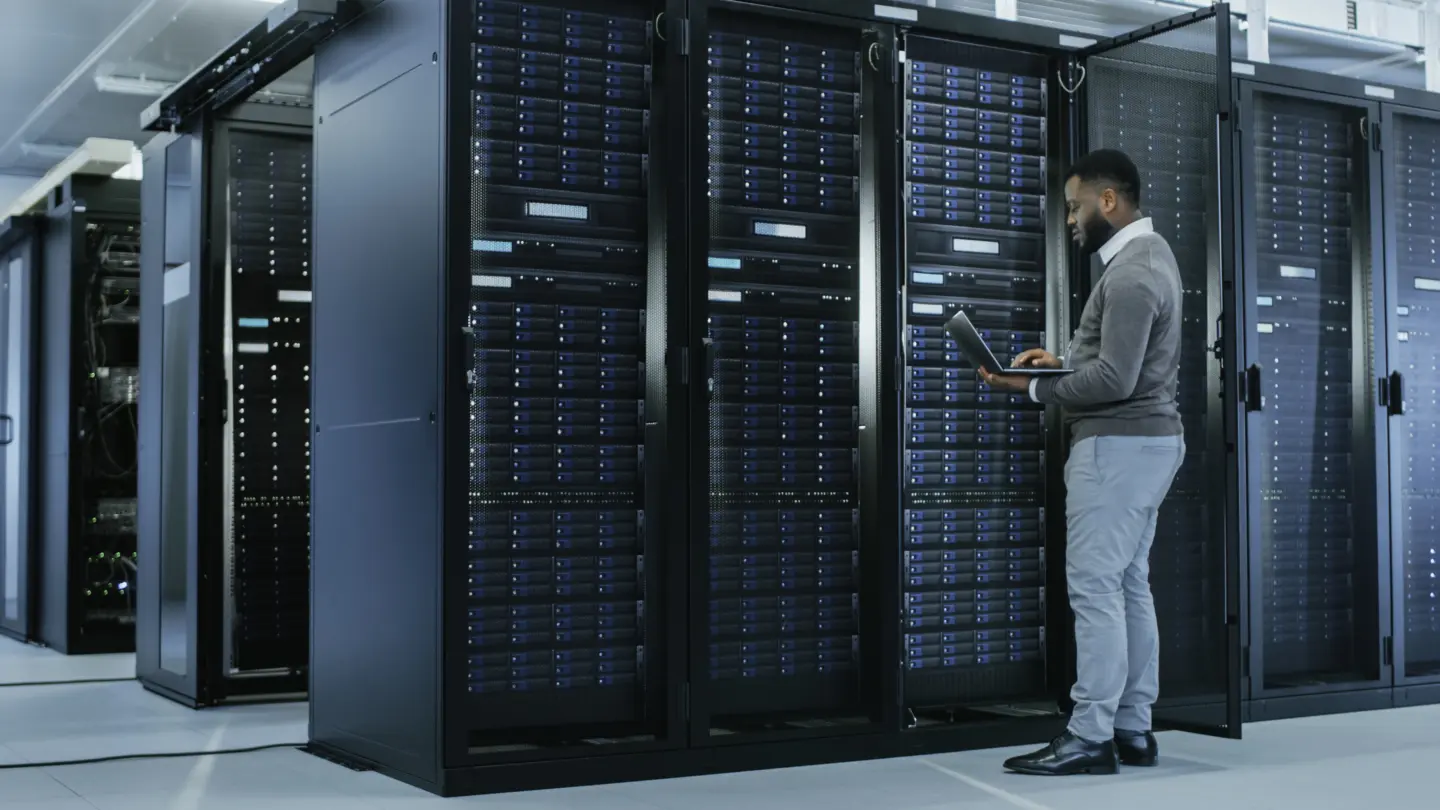
Why the Speed and Scale of Data Centers Makes BIM Validation Critical
Author: Kacie Goff – a guest writer from the U.S. specializing in AEC industry topics, in collaboration with Solibri.
One particular sector of the architecture, engineering, and construction (AEC) industry is experiencing explosive growth. Experts predict that the data center construction market will nearly double over the next five years. During that time period, McKinsey data says that companies will globally invest nearly $7 trillion a year on developing data center infrastructure.
“The pace of data center growth has been breakneck for the last few years.”
– Matthew Lohden, Accenture
Unsurprisingly, AEC firms want to jump on board and get a slice of the pie. Building these kinds of facilities means stepping into some specific requirements, though. Fortunately, when properly validated, building information modeling (BIM) helps teams avoid the biggest pitfalls.
We spoke with Matthew Lohden, Senior Consultant in the Innovation Division of Accenture’s Infrastructure & Capital Projects arm, about these specialized types of projects. He had some guidance to help teams use validated BIM to succeed in data center design and construction.
The Unique Challenges in Building Data Centers
Planning and constructing data centers introduces distinct requirements for all firms involved. To navigate those, it helps to break them into categories and look at them individually.
Here are three unique challenges firms face when involved in building data centers:
#1: Specialized Project Requirements
These projects are purpose-built, so the project owner often comes to the AEC professionals with a broad range of specific requirements. Firms get tasked with designing and constructing projects that can adhere to the owner’s specifications for:
- Cooling
- Cybersecurity
- Energy efficiency
- Fire suppression
- Floor loading capacity
- Latency avoidance
- Thermal management
- Physical security
- Power
And this only skims the surface. Data centers are not unlike hospitals, in that they might seem simple on the surface, but a lot is going on underneath. A variety of sophisticated components need to fit safely in the space.
“The really big challenges in data centers are getting all of the electrical, telecommunications, and mechanical systems to fit in the most efficient package possible. That doesn’t necessarily mean the tightest package because there has to be room for everybody to move around and maintain and update the place efficiently and safely.”
– Matthew Lohden, Accenture
#2: Alignment With Local Regulations
Data centers layer their unique and stringent requirements on top of the need to comply with local regulations. These can be strict for facilities this large, particularly because they will most likely pull from the local power grid and municipal water supply.
“You have to combine local building requirements with complex client specifications.”
– Matthew Lohden, Accenture
As a result, the authorities having jurisdiction (AHJs) tend to be heavily involved in these kinds of projects. The data center typically needs permits for:
- Air quality
- Water use
- Noise
- Mechanical/HVAC
- Fire protection
The AEC firms involved need to be ready to not just comply with regulation, but also to interface with the AHJ to secure the required permitting.
#3: Safety
The specialized requirements of data centers introduce a special set of safety risks. Those range from high voltages to working at heights installing cable tray runs.
And that’s not all. The granular level of detail required for data center projects means that when teams don’t have a clear plan, they might install components improperly. Rework ties directly to increased safety risks. That makes doing things right the first time particularly important on already-dangerous data center projects.
“In data center construction, safety is a huge concern.”
– Matthew Lohden, Accenture
Using BIM Validation To Put Data Center Construction on Rails
Fortunately, AEC firms aren’t without resources to help them mitigate the above risks. They can turn to BIM.
A properly validated model gives teams a way to plan the project to the required level of detail. Then, they can validate that the model meets regulatory requirements for AHJs. Finally, they can use the model to execute what’s been planned and permitted.
Specifically, AEC teams can use a thoroughly validated model to:
#1: Meet Project Requirements the First Time Around
By modeling the project digitally, teams can make sure components fit together and function as needed.
This goes beyond clash detection. Checking for conditional clearances allows teams to make sure the project works as intended after handover. They can check that a corner is big enough for a scissor lift to navigate, for example, or confirm that bollards are the required distance from curbs and generators. They can make sure that water lines aren’t running above electrical equipment, and that maintenance teams have sufficient room to access electrical panels.
Better still, by creating rules to check the model, AEC teams can seamlessly apply requirements across the entirety of large-scale projects like data centers.
In short, when paired with sophisticated model checking, BIM helps firms make sure things are where they should be — and not where they shouldn’t — before they put people on site. Just as importantly, a validated model provides the guidance onsite teams need to properly perform installation.
“One of the things Solibri is really good at is looking to see whether required components are included — and included properly.”
– Matthew Lohden, Senior Consultant, Innovation Division, Infrastructure & Capital Projects (I&CP), Accenture
#2: Comply With Regulations
Similarly, AEC firms can apply rules to the model to ensure compliance with local regulations. They can set a rule that shows the maximum distance between fire hydrants, for example, then check the entire project for compliance.
Better still, the model gives them a 3D way to show the AHJ that the project aligns with local rules. AHJs increasingly ask for BIM-based visuals like 3D cutaways. The validated model makes conforming faster and easier.
When AHJs require revisions, BIM makes that faster, too. Teams can make the change in the model. Then, by running rule-based checking, they get a way to make sure everything still fits and functions as intended alongside that adjustment.
#3: Keep Teams Safe
Because a properly validated model catches problems in the digital realm, it should make for fewer issues on the jobsite. In reducing rework, it helps to keep workers safer.
Take underground bus ducts as an example. These can run cooler and take up less space, among other benefits, but using them requires specialized planning. If the concrete encasement would collide with the footing of a bollard, for example, model-checking catches that. This way, teams can correct the clash, then use a second round of model checks to make sure the new bollard placement still meets the project’s requirements.
If all of that didn’t happen digitally, workers on site would be subject to excess labor and more safety risk.
Three Simple Steps To Apply Model Validation in Data Centers
Validating BIM eases the aforementioned challenges in data center design and construction.
These three steps help teams arrive at trustworthy models that drive the data center project toward success:
#1: Perform a Model Review
Best practice here is to create a federated model that combines all of the different disciplines’ models to the main model. Then, run the entire project through the established rule-based checks.
This model review should be conducted on an ongoing basis, especially after any element changes. For this to be possible, firms need to choose model-checking software that lets them run checks quickly and efficiently. Ideally, all it takes is the click of a button. This is possible when using an automated, rule-based solution.
Then, teams can quickly check for both intradiscipline clashes (elements within a model clashing) and interdisciplinary clashes (elements from different models clashing).
Beyond that, the right rules help check for duplicate components, clearances, and other requirements unique to the data center.
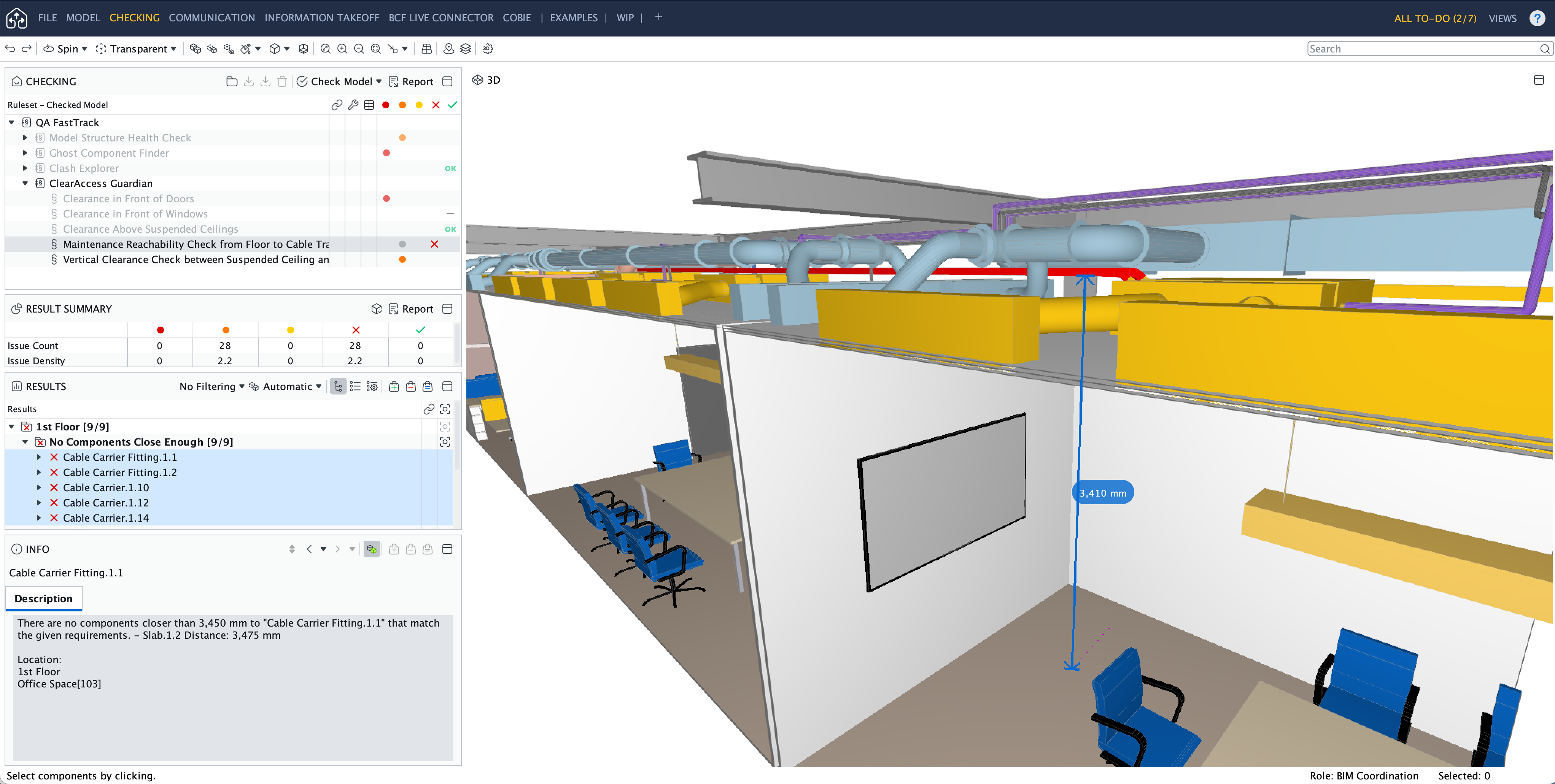
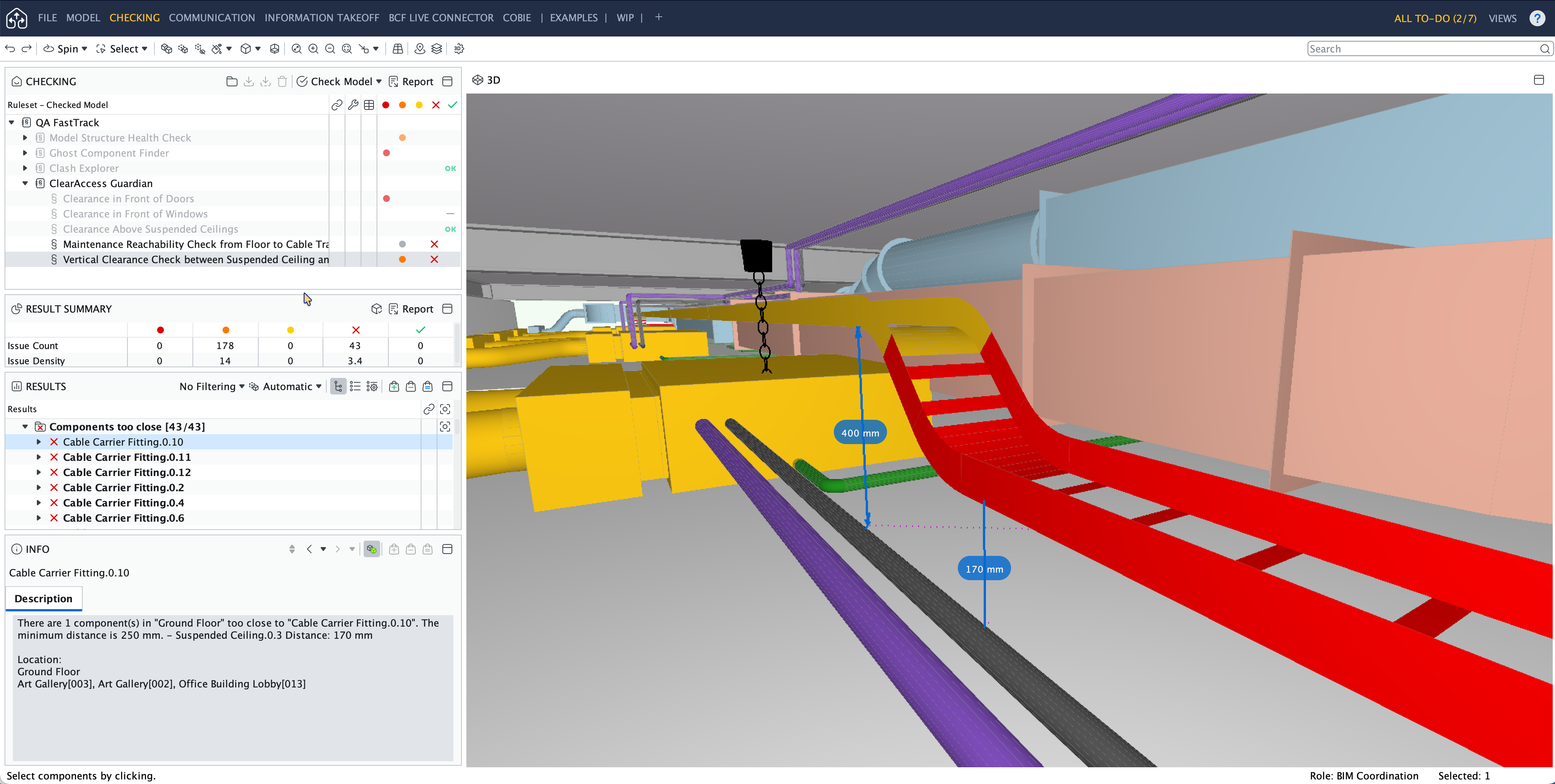
A component distance rule, for example, can check cable tray positioning. Are trays high enough above the ceiling for the scissor lift to travel underneath? Are they low enough to be reached by that scissor lift for maintenance?
#2: Flag and Organize Issues
This step shouldn’t be time-consuming, even on a large data center project that might have thousands of issues. The right system helps to collect issues together for batch resolution.
It also makes it easy to identify what requires the most attention. Ranking issues by their severity level allows teams to move at the speed data centers require. When users can filter the checked results, they get an easy way to focus on what’s most urgent.
#3: Correct the Issues
In most cases, this means notifying the appropriate stakeholders to make the required changes. Good model-checking software creates actionable reports that highlight the issue clearly for the parties involved.
Great model-checking software lets you connect issues to a BIM collaboration format (BCF) server so teams can see issues directly in their authoring platform. This helps them resolve the issues quickly and accurately, then push them back to the model-checking software. Then, teams can confirm that the change resolves the flagged issue and doesn’t introduce new ones.
Keeping Ahead of the Curve of Data Center Construction
Data center design and construction is already highly complex. On top of that, it’s changing.
There’s a shift from air-cooled to liquid-cooled. Companies continually tweak the form factors. Plus, AI data centers have additional hurdles (e.g., higher rack densities [30–100+ kW per rack], more aggressive cooling and power systems).
As requirements only get more sophisticated, validated models prove increasingly valuable.
“Right now, I can’t imagine that anyone is building data centers without BIM. With Solibri, we can do a thorough, complete, and detailed model coordination review much more quickly. Plus, the reports are actually actionable.”
— Matthew Lohden, Accenture
Want to learn more about how Solibri can help your firm achieve the speed and scale required for data centers? Contact us. We would be happy to help you find the tools your team needs for any of its data center projects.